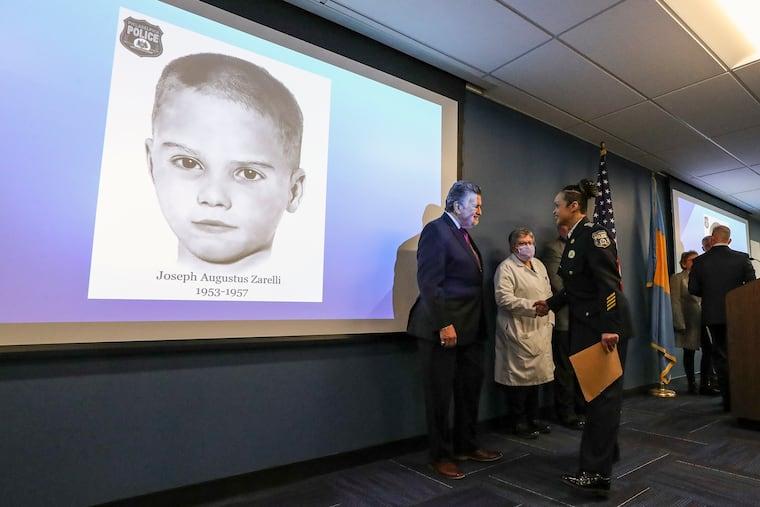

Historical location where the Boy in the Box case was discovered in Philadelphia.

Detectives investigating one of America’s most famous child murder mysteries.

Cold-case investigators reviewing decades-old evidence files.

Modern forensic genealogy laboratory analyzing DNA samples.

Newspaper coverage of the mysterious child murder case.

Archived evidence preserved for future investigation.
The Boy in the Box: How a Murder Mystery That Haunted America for 65 Years Was Finally Reopened—and Could Still Reveal More Secrets
Some murder cases disappear from public memory after a few years. Others become legends, haunting generations of investigators and ordinary citizens alike. Few cold cases fit that description better than the mystery known as “The Boy in the Box.”
For more than six decades, America searched for answers after the body of a young child was discovered abandoned in a cardboard box near Philadelphia. The victim had no identification, no known family, and no obvious clues pointing to his identity. Despite countless investigations, thousands of leads, and widespread media attention, the child remained a mystery.
Yet unlike many cold cases, this story took an extraordinary turn. Advances in modern forensic science eventually allowed investigators to identify the victim decades after his death. Even today, however, many questions remain unanswered, and experts believe the murder investigation itself may still have more secrets waiting to be uncovered.
A Chilling Discovery
On February 25, 1957, a young man checking muskrat traps in a wooded area of Philadelphia, Pennsylvania, discovered a cardboard box lying near the roadside.
Inside was the body of a small boy.
The child appeared to be between four and six years old. Investigators immediately recognized that they were facing a tragic and disturbing homicide.
The victim showed signs of severe abuse and neglect. There were visible injuries, indications of mistreatment, and evidence suggesting that his life had been extremely difficult long before his death.
Police quickly launched an intensive investigation. What they did not realize was that the case would become one of the most famous unsolved murders in American history.
The Search for an Identity
One of the first goals of investigators was identifying the child.
His fingerprints were taken and distributed nationwide. Photographs were shared with police departments across the country. Missing-child reports were reviewed. Newspapers published stories hoping someone would recognize him.
No one came forward.
Weeks turned into months. Months became years.
Despite massive publicity, nobody could identify the victim.
The mystery shocked investigators. How could a young child seemingly disappear without a trace? Why had no family member reported him missing? Why did no relative come looking for him?
As public interest grew, the child became known simply as “The Boy in the Box.”
Thousands of Leads—and No Answers
The investigation generated enormous public attention.
Police received thousands of tips from citizens claiming to know the child’s identity or the circumstances of his death. Detectives chased countless leads across multiple states.
Several theories emerged.
Some believed the child came from an orphanage. Others suspected illegal adoption networks. Some investigators explored the possibility that he had been hidden from society for years.
One woman later claimed that the child had been purchased by her abusive mother and subjected to years of mistreatment before being killed. Her account contained details that appeared consistent with evidence from the scene.
However, investigators could never fully verify her story.
Without definitive proof, the case remained unsolved.
Decades of Frustration
As years passed, many feared the mystery would never be solved.
The original detectives retired. Witnesses died. Evidence aged. Potential suspects disappeared.
Yet something remarkable happened.
The case never left public consciousness.
True-crime researchers continued studying the evidence. Journalists revisited the mystery. Amateur investigators organized groups dedicated to finding answers.
The child’s face appeared in documentaries, books, magazines, and television programs.
Every few years, renewed interest sparked fresh attempts to identify him.
Still, no breakthrough came.
The Rise of Modern Forensics
The late twentieth and early twenty-first centuries transformed criminal investigations.
DNA testing became one of the most powerful tools in law enforcement history. Cases that had remained unsolved for decades suddenly became solvable.
Investigators began reopening old evidence boxes from long-forgotten crimes.
Cold cases across America were solved using technology that did not exist when the crimes occurred.
The Boy in the Box case became a prime candidate for renewed forensic examination.
Authorities carefully preserved evidence from the original investigation and began exploring whether modern scientific techniques could uncover the victim’s identity.
A Historic Breakthrough
In 2022, after more than 65 years, investigators finally achieved what many had thought impossible.
Using advanced DNA analysis and forensic genealogy, authorities identified the child.
His name was Joseph Augustus Zarelli.
The announcement shocked both investigators and the public.
For decades, Joseph had been known only as a mystery victim. Now he had a name, a birth certificate, and a place within a family history.
The breakthrough demonstrated the extraordinary power of modern forensic science.
What generations of detectives could not accomplish through traditional investigation methods was achieved through DNA technology and genealogical research.
The identification represented one of the most significant cold-case breakthroughs in American criminal history.
Why the Murder Case Is Still Not Fully Solved
Although Joseph’s identity was finally established, many important questions remain unanswered.
Who killed him?
Who was responsible for the abuse he allegedly suffered?
Were multiple people involved?
Did individuals knowingly conceal information from investigators?
Authorities have not publicly identified a killer. Many people connected to Joseph’s life are no longer alive, making the search for answers significantly more difficult.
However, investigators have not closed the case.
Modern detectives continue examining historical records, witness statements, family connections, and preserved evidence.
The possibility remains that additional information could emerge.
How Modern Technology Could Reveal More
Today’s investigators possess tools unimaginable to detectives in 1957.
Digital record databases allow researchers to cross-reference millions of historical documents within seconds.
Artificial intelligence can assist in analyzing large collections of records and investigative files.
Advanced DNA techniques continue evolving, enabling scientists to extract information from increasingly degraded biological samples.
Forensic genealogy itself continues to improve each year.
Evidence once considered useless may eventually yield new clues.
In many cold cases, breakthroughs occur not because investigators discover entirely new evidence but because technology allows them to reinterpret evidence that already exists.
The Boy in the Box investigation may benefit from exactly this process.
Why Cold Cases Matter
Some people wonder why authorities continue investigating crimes committed decades ago.
The answer is simple.
Justice has no expiration date.
Every victim deserves to be identified. Every family deserves answers. Every unsolved homicide represents unfinished business for investigators and communities alike.
Cold-case investigations also provide valuable lessons for modern law enforcement. They reveal investigative mistakes, highlight advances in forensic science, and demonstrate the importance of preserving evidence.
Most importantly, they remind society that victims should never be forgotten.
The Legacy of Joseph Augustus Zarelli
For generations, the child found in a cardboard box symbolized one of America’s greatest criminal mysteries.
Today, Joseph Augustus Zarelli is no longer anonymous.
His name has been restored. His story is known. His existence is acknowledged.
Yet the investigation continues.
Detectives still hope that surviving records, family histories, witness accounts, or future technological advances may provide additional answers about what happened during the final days of his life.
The case stands as a powerful example of why cold cases should never be abandoned.
A mystery that seemed impossible to solve for 65 years eventually yielded one of its biggest secrets. That success offers hope that other historic murder investigations may one day reach similar breakthroughs.
The Boy in the Box may finally have a name, but the search for complete justice is not over. As forensic science continues advancing, investigators remain determined to uncover every possible truth hidden within this tragic chapter of American history.
Leave a Reply